Frozen Shoulder (Adhesive Capsulitis): A Complete Patient Guide
By Dr. Pritpal Singh Saini, MBBS, DNB ORTHOPAEDICS
Fellowship in Arthroscopy & Joint Replacement | Understanding shoulder pain,
stiffness, recovery, injections, physiotherapy and when surgery may be considered.
Frozen shoulder, medically called adhesive capsulitis,
is a condition in which the shoulder becomes progressively painful and stiff.
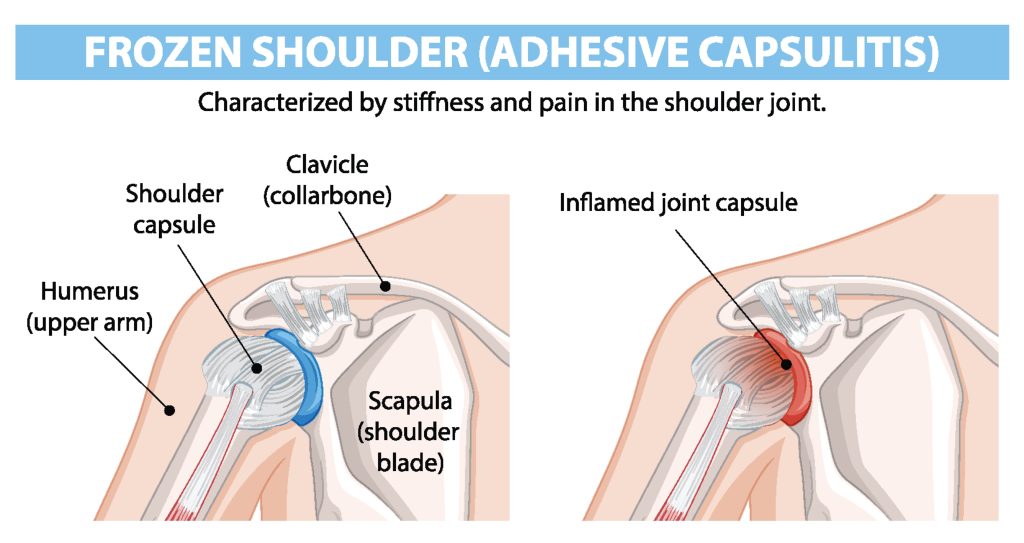
The capsule surrounding the ball-and-socket shoulder joint becomes inflamed,
thickened and tight, limiting the amount the joint can move.
Shoulder joint anatomy: The ball-and-socket construct illustrating the glenohumeral capsule which contracts and thickens in adhesive capsulitis.
The characteristic feature is restriction of both active movement
(movement you perform yourself) and passive movement
(movement when the doctor moves your relaxed arm). External rotation —
turning the forearm outward with the elbow beside the body — is commonly one
of the most restricted movements.
Important: Frozen shoulder is different from a rotator-cuff problem.
In many rotator-cuff disorders, actively lifting the arm may be painful or weak while
passive shoulder movement is relatively preserved. In adhesive capsulitis, passive
movement is also genuinely restricted.
2. Who Is More Likely to Develop It?
Frozen shoulder is most often seen in middle age. Sometimes it begins without an
obvious injury; in other patients it follows a period in which the arm has not been
moving normally.
Diabetes mellitus is an important associated condition.
Thyroid disease is also associated with adhesive capsulitis.
It may occur after a shoulder injury or shoulder surgery.
Prolonged limitation of arm movement can increase the likelihood of stiffness.
A previous frozen shoulder increases the possibility of the condition occurring in the other shoulder.
If you have diabetes, keeping your diabetes reviews and glucose management up to date
remains important. Your doctor may also consider whether an associated medical condition
needs assessment depending on your history.
3. Common Symptoms
Gradually increasing shoulder pain, often without one major injury.
Pain that may be worse at night and disturb sleep.
Increasing difficulty lifting the arm overhead or away from the body.
Difficulty reaching behind the back to wear clothes, fasten garments or use a back pocket.
Difficulty combing hair, bathing, dressing or reaching a shelf.
A feeling that the shoulder is becoming progressively stiff or “blocked.”
Pain and stiffness do not always progress at exactly the same rate. Some patients are
mainly troubled by pain early on, while others present later with stiffness as the
dominant problem.
4. The Three Classical Stages
Frozen shoulder is traditionally described in three overlapping stages. These are useful
for understanding the condition, but an individual patient may not fit neatly into a
fixed calendar.
Freezing / Painful Stage
Pain gradually increases and shoulder movement becomes progressively restricted. Night pain can be prominent.
Frozen / Stiff Stage
Pain may begin to settle, but stiffness remains marked and everyday activities can be difficult.
Thawing / Recovery Stage
Shoulder movement gradually returns. Improvement is often slow and takes place over many months.
Recovery is usually gradual, not overnight. Authoritative patient guidance
describes a course that can last many months and sometimes one to two years or longer.
Persistent limitations can occur, so follow-up is appropriate when progress is poor.
5. How Is Frozen Shoulder Diagnosed?
The diagnosis is primarily based on your history and physical examination.
Your doctor compares active and passive shoulder movement and looks for the characteristic
capsular pattern of restriction.
An MRI is not automatically required. Imaging is selected according to the
clinical situation. A shoulder X-ray may be used to exclude other causes of painful stiffness,
particularly arthritis or a bony problem. Ultrasound or MRI may be considered when the diagnosis
is uncertain or another condition such as a rotator-cuff tear is suspected.
Conditions that may sometimes mimic or coexist with frozen shoulder include shoulder
osteoarthritis, rotator-cuff disease, calcific tendinitis, previous fracture-related stiffness
and pain referred from the neck.
6. Treatment: A Stepwise Approach
Treatment is individualized according to how painful the shoulder is, how much movement has
been lost, the stage of the condition, your general health and how much your daily activities
are affected. Most patients begin with non-operative treatment.
1. Pain Control
Appropriate analgesic or anti-inflammatory medication may be used when medically suitable, together with heat or cold according to comfort.
2. Guided Movement
Gentle mobility exercises and physiotherapy are used to preserve or progressively regain movement without repeatedly provoking severe pain.
3. Steroid Injection
An intra-articular corticosteroid injection may provide useful short-term pain and disability improvement, particularly when pain is limiting rehabilitation.
Hydrodilatation
Hydrodilatation (distension of the shoulder joint capsule using injected fluid, usually with
local anaesthetic and often corticosteroid) is another treatment option used in selected
patients. Evidence suggests it can help some patients, although no single intervention is
clearly best for everyone.
When Is Surgery Considered?
Surgery is not the first treatment for most frozen shoulders. If substantial
pain and restriction persist despite an adequate course of non-operative management, specialist
options may include manipulation under anaesthesia or arthroscopic capsular release.
The large UK FROST trial found no clinically important superiority of arthroscopic capsular
release, manipulation under anaesthesia, or early structured physiotherapy with steroid injection
at the main follow-up point. This supports shared decision-making rather than assuming that a more
invasive procedure automatically gives a better result.
7. Exercise and Physiotherapy: How Hard Should You Push?
Movement is important, but aggressively forcing a very painful shoulder is not the goal.
Exercises should be matched to your irritability and stage. During a highly painful phase, gentle
pain-limited mobility may be more appropriate; stretching can be progressed as pain settles.
Perform exercises taught specifically for your shoulder rather than inventing strenuous routines.
Avoid repeatedly forcing the arm through sharp or severe pain.
Do not keep the shoulder completely immobile unless there is a separate medical reason to do so.
Progress range-of-motion and later strengthening according to your clinician or physiotherapist.
Patient safety: Exercise dosage should be individualized. If an exercise causes
severe or progressively worsening pain, new weakness, numbness, swelling, or a new injury,
stop and seek medical advice rather than simply increasing the repetitions.
8. What Can You Do at Home?
Keep the shoulder gently moving within the range advised to you.
Use heat or cold packs safely, wrapped in cloth, according to which feels more comfortable.
Modify painful activities temporarily rather than completely abandoning use of the arm.
Use prescribed or advised pain medication only when it is suitable for you.
Be consistent with your rehabilitation rather than doing occasional forceful stretching.
Expect progress to be measured over weeks and months rather than days.
If night pain is troublesome, some people find it more comfortable to sleep on the opposite
side with a pillow supporting the affected arm. This is a comfort strategy, not a treatment
for the capsule itself.
9. When Shoulder Pain May Not Be “Just Frozen Shoulder”
Seek medical assessment promptly if symptoms are unusual for a gradual frozen shoulder or if
you develop features suggesting injury, infection, nerve involvement or another cause.
Get urgent medical attention for:
A major injury with deformity or inability to use the arm.
A hot, markedly swollen or red shoulder, especially with fever or feeling unwell.
Sudden new arm weakness, persistent numbness or neurological symptoms.
Severe unexplained pain associated with chest pain, breathing difficulty or other acute systemic symptoms.
10. Frequently Asked Questions
Will frozen shoulder get better?
Many patients improve gradually, but the process is slow. Recovery may take many months and
sometimes one to two years or longer. The degree and speed of recovery vary between patients.
Is a steroid injection compulsory?
No. It is one option. It may be particularly helpful for short-term pain relief in an appropriate
patient, making sleep and rehabilitation easier. Risks and suitability should be discussed with
your treating doctor.
Can physiotherapy make frozen shoulder worse?
Appropriately dosed rehabilitation is a core treatment. However, repeatedly forcing a very painful
shoulder can aggravate symptoms. The intensity should be matched to the stage and irritability of
the shoulder.
Do I need an operation?
Usually not initially. More invasive procedures are generally reserved for persistent, functionally
important symptoms despite an adequate trial of non-operative treatment.
Can frozen shoulder come back?
Recurrence in the same shoulder is considered uncommon, but the opposite shoulder can be affected
in some patients, particularly in those with associated risk factors.
Authentic Sources & Further Reading
This patient guide is educational and is based on established orthopaedic and medical sources.
The links below are provided so patients can read the underlying guidance directly.
Medical information changes as new evidence emerges. This page is for general patient education
and does not replace an examination, diagnosis or individualized treatment plan.
Medical Review & Credentials
Dr. Pritpal Singh Saini,
MBBS, DNB Orthopaedics
Fellowship in Arthroscopy & Arthroplasty
Medical information on this page is intended for patient education
and should not replace an in-person clinical assessment.