Understanding the Rotator Cuff
The shoulder is a ball-and-socket joint, but unlike the hip, the shoulder's socket is very shallow. To keep the ball securely in place and allow you to lift and rotate your arm, you rely on a group of four distinct muscles and their tendons: the Supraspinatus, Infraspinatus, Teres Minor, and Subscapularis. Together, these form the Rotator Cuff.
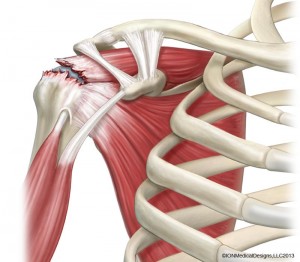
A rotator cuff tear occurs when one or more of these tendons is pulled away from the bone (most commonly the supraspinatus tendon). Tears can happen abruptly due to a traumatic injury, like a fall on an outstretched hand, or they can develop slowly over time due to age-related wear and tear, chronic impingement, and repetitive overhead activities.
Symptoms & Diagnosis: The Agony of Night Pain
One of the hallmark symptoms of a rotator cuff tear is severe night pain. Patients often find it nearly impossible to sleep on the affected shoulder and are frequently awakened by a deep, aching pain. During the day, you may experience significant weakness when trying to lift your arm above your head or reaching behind your back.
To confirm the diagnosis, we perform a thorough physical examination to test your strength and isolate which specific tendon is damaged. We then utilize an MRI (Magnetic Resonance Imaging) scan. The MRI is the gold standard because it not only confirms the tear but also tells us the size of the tear, how far the tendon has retracted (pulled back), and the quality of the remaining muscle tissue.
When is Surgery Not Needed?
Not all rotator cuff tears require surgery. If you have a partial-thickness tear (the tendon is frayed but not completely detached), or if you are a low-demand, elderly patient whose primary goal is simply pain relief, we often start with conservative management.
This includes a dedicated course of physiotherapy to strengthen the surrounding shoulder muscles, allowing them to compensate for the damaged tendon. We may also use targeted steroid or biologic injections into the subacromial space to calm severe inflammation, block pain, and allow you to participate effectively in rehabilitation.
Arthroscopic Rotator Cuff Repair
For complete tears, or for active individuals wanting to restore full strength and function, surgical repair is the definitive treatment. As a fellowship-trained Arthroscopy specialist, my primary approach is Arthroscopic (Keyhole) Repair.
Through 3 or 4 tiny incisions, we insert a specialized camera and miniature surgical instruments. We first clean out any inflamed tissue (bursitis) and shave down any bone spurs that may be cutting into the tendon. We then use Suture Anchors—tiny screws loaded with high-strength surgical threads—that are embedded into the bone.
I frequently utilize a Double-Row Fixation technique. Instead of just one line of anchors, we use an inner row and an outer row to crisscross the sutures over the tendon. This presses the torn tendon firmly flat against its natural bony "footprint," providing an incredibly strong, watertight repair that dramatically improves biological healing.
The Mini-Open Technique
While arthroscopy is excellent for the vast majority of tears, a Mini-Open Repair is sometimes necessary for massive, severely retracted, or highly complex tears that are difficult to mobilize solely through keyholes.
The "mini-open" procedure is a hybrid approach. We begin with arthroscopy to inspect the joint, clean the arthritis, and prepare the bone. Then, we make a small (3 to 5 cm) incision over the top of the shoulder. This slightly larger window allows us direct, hands-on access to grab a severely shrunken tendon, release tight scar tissue, and securely sew the tendon back to the bone using bone anchors. It provides the mechanical strength of a traditional open surgery but preserves the shoulder muscle (deltoid), leading to a much faster recovery than traditional large-incision surgeries.
Post-Op Recovery & Rehabilitation
Repairing the tendon is only half the battle; the tendon must biologically fuse back to the bone. Because this takes time, you will wear a specialized shoulder sling with an abduction pillow for about 4 to 6 weeks to protect the delicate repair.
During the first month, your physiotherapist will perform passive range of motion exercises—moving your arm for you so the muscle doesn't flex and pull on the stitches. After 6 weeks, you will transition to active movement, and by 10 to 12 weeks, we begin formal strength training. Returning to heavy lifting or overhead sports generally takes about 4 to 6 months. Dedication to your physiotherapy protocol is the absolute key to regaining a strong, pain-free shoulder.