1. What is the basic difference between plaster treatment and surgery?
Plaster treatment
A plaster cast or splint keeps the fractured bone sufficiently still while the body's natural healing process joins the bone. It is a form of non-operative treatment. For some fractures, this is all that is required.
A fracture may be suitable for plaster or another non-operative treatment when it is reasonably aligned, stable, expected to remain acceptably aligned, and there is no major open injury or neurovascular problem.
What exactly does surgery do?
Fracture surgery generally involves reduction—bringing the broken fragments into an acceptable position—followed by fixation using an appropriate implant such as plates and screws, an intramedullary nail, screws, wires/pins or an external fixator. Rehabilitation then progresses according to the fracture and fixation.
The objective is to provide appropriate stability for bone healing and functional recovery.
2. Does every fracture require surgery?
No. Many fractures can be treated successfully without surgery. The key word is stable.
- The fracture is reasonably aligned.
- The alignment is expected to remain acceptable.
- The joint surface is not significantly disrupted.
- There is no open injury requiring operative management.
- There is no significant nerve or blood-vessel problem.
- The patient can safely comply with immobilisation and follow-up.
- The expected functional result with non-operative treatment is acceptable.
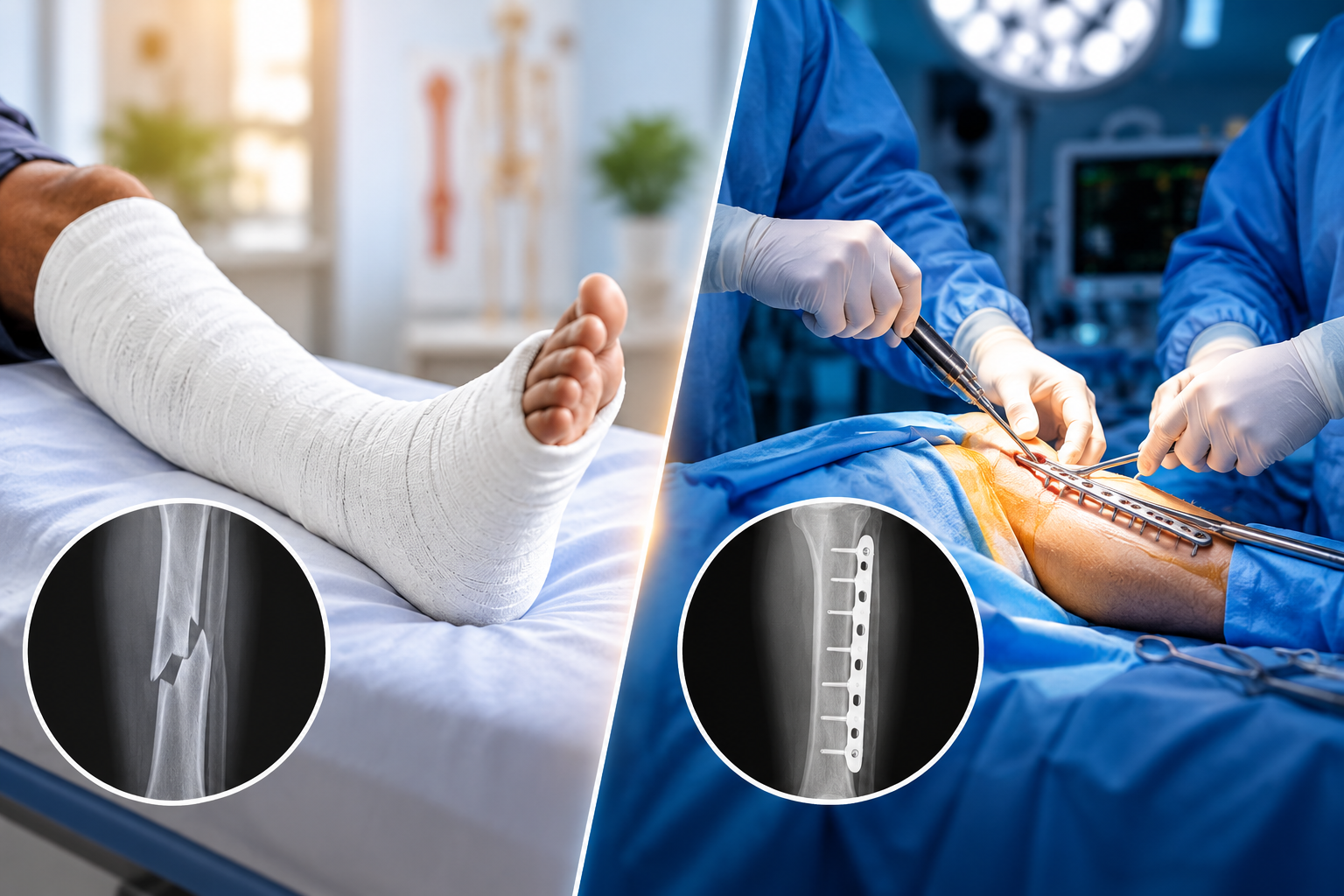
An initially acceptable fracture can still prove unstable later, which is why follow-up and repeat X-rays may be important.
3. When might surgery be recommended?
Surgery may become necessary or preferable when the fracture cannot be expected to heal in a satisfactory functional position with plaster alone.
- Significantly displaced fractures: the fragments cannot be adequately aligned or maintained.
- Unstable fractures: alignment is likely to be lost after reduction.
- Fractures involving a joint: selected joint fractures may benefit from accurate restoration and stable fixation.
- Open fractures: contamination and infection risk require urgent assessment and treatment.
- Fracture-dislocations: urgent reduction and sometimes operative stabilisation are required.
- Associated vascular or nerve injury: significant compromise can require urgent intervention.
- Harmful prolonged immobilisation: in selected fractures stable fixation can permit earlier movement or mobilisation.
4. Why not operate on every fracture?
Surgery is a treatment tool, not a requirement for every fracture. Surgery creates its own risks, including infection, bleeding, anaesthetic complications, blood clots, nerve or vessel injury, wound problems, implant-related problems, fixation failure, delayed union, non-union, malunion, stiffness, persistent pain, post-traumatic arthritis and possible revision surgery.
The question should therefore be: “For this particular fracture and this particular patient, which treatment is expected to provide the safest and most useful functional result?”
5. What is a slab and why is it put first instead of a complete plaster cast?
A slab, backslab or splint does not completely surround the limb. A full circular cast does. The main reason for using a slab initially is swelling.
Immediately after a fracture, the injured tissues can swell considerably. If a complete rigid circular cast is applied while swelling is still increasing, it can become dangerously tight.
6. Why can a tight full cast be dangerous?
- Increasing or severe pain
- Compression of nerves causing numbness or tingling
- Reduced blood circulation
- Increasing swelling of fingers or toes
- Skin pressure and pressure sores
- In severe situations, serious compromise of the limb
7. Why approximately 7 days before changing the slab to a cast?
The often-mentioned period of approximately one week is a common review point, not a universal rule. The initial swelling usually settles progressively. Once swelling has reduced sufficiently, the doctor may decide that a full cast can be applied safely if full casting remains appropriate.
The timing depends on the fracture, swelling, skin condition, stability, reduction, examination and follow-up X-rays.
8. Why not put a full cast immediately if plaster is ultimately needed?
The fracture is not the only thing that has been injured. Muscles, tendons, ligaments, skin and blood vessels may also be swollen. A rigid circular cast cannot expand much as swelling increases. A slab provides room during this period.
The typical pathway may be: injury → assessment/X-ray → reduction if required → slab → swelling settles → review → full cast if appropriate → follow-up X-rays.
Why is a plaster slab applied even when surgery is already planned?
This is a very common question from patients and families: “If surgery has already been decided, why are you putting a plaster slab first?”
The answer is simple: the slab and the surgery have different jobs. A temporary slab is often used to protect and support the injured limb while the swelling settles, the skin is monitored, the patient is medically prepared and the operation is scheduled at the appropriate time.
- It supports the fracture: The limb is kept more comfortable and unnecessary movement is reduced.
- It accommodates swelling: A slab does not completely encircle the limb, so it provides more room for swelling than a tight circumferential cast.
- It protects the skin: The condition of the skin and soft tissues matters when deciding the timing of surgery.
- It buys safe preparation time: The patient may need blood tests, medical assessment, anaesthesia evaluation, control of diabetes or blood pressure, medication review, or other preparation before surgery.
- It does not usually replace the planned operation: If the fracture genuinely needs fixation, the slab is generally a temporary measure while definitive treatment is arranged.
For some fractures, operating immediately is appropriate. For others, especially when there is substantial swelling or soft-tissue injury, waiting for the tissues to become safer may be part of good fracture management. The exact timing depends on the fracture, swelling, skin condition, general health and the urgency of the injury.
So please do not think, “The doctor is applying a plaster first to earn extra money before surgery.” A medically indicated slab is a treatment step in its own right. The decision should be based on protecting the limb and preparing the patient safely for the next stage of treatment.
Of course, not every fracture needs a slab before surgery, and the type and duration of immobilisation should be decided by the treating orthopaedic team.
9. Is a slab weaker than a full cast?
Generally, yes. A slab does not provide the same circumferential support as a properly applied full cast. But this is often intentional. During the early swelling phase, allowing room for swelling can be more important than providing maximum circumferential restriction.
10. What happens if the fracture moves inside the plaster?
A fracture can sometimes shift even after an apparently satisfactory reduction. Follow-up examinations and X-rays help detect this. If the fracture loses acceptable alignment, treatment may need to change to repeat manipulation, a different immobilisation method or surgery, depending on the fracture.
11. What are the advantages of plaster treatment?
- No surgical wound
- No surgical implant
- Avoids operative and anaesthetic risks associated with surgery
- Less invasive
- Can provide excellent healing in appropriately selected fractures
12. What are the disadvantages of plaster treatment?
- Joint stiffness
- Muscle weakness and wasting
- Skin irritation or pressure sores
- Swelling or a cast becoming too tight
- Loss of fracture alignment
- Delayed healing, malunion or non-union in selected fractures
- Difficulty walking or performing daily activities
- Complications associated with prolonged lower-limb immobilisation in susceptible patients
13. What are the advantages of fracture surgery?
- Better control of alignment when plaster cannot maintain it.
- Stable fixation of selected unstable fractures.
- Potential for earlier movement of appropriate joints.
- Potential for earlier mobilisation in selected injuries.
- More predictable maintenance of reduction in appropriately selected fractures.
14. What are the risks of fracture surgery?
- Infection
- Bleeding
- Anaesthetic or medical complications
- Nerve or blood-vessel injury
- Blood clots
- Wound-healing problems
- Implant irritation, loosening or failure
- Delayed union or non-union
- Malunion
- Persistent stiffness or pain
- Need for further surgery in selected cases
15. Does surgery mean the bone heals faster?
Not necessarily. Surgery primarily aims to obtain and maintain appropriate alignment and stability. Stable fixation may permit earlier movement and rehabilitation in selected injuries, but biological fracture healing still takes time.
16. What about elderly patients?
Age alone should not determine whether a patient receives plaster or surgery. Important considerations include the fracture, pre-injury mobility, frailty, bone quality, cognitive and functional status, comorbidities, home support and the risks of prolonged immobilisation.
An independently mobile older adult and a previously bed-bound older adult may have very different treatment priorities even with a similar fracture.
17. Why can avoiding surgery sometimes be more dangerous in an elderly patient?
In some fractures, particularly selected hip fractures, the problem is not only the broken bone. Prolonged immobility can contribute to muscle loss, chest complications, blood clots, pressure sores, deconditioning, loss of independence and difficulty returning to walking.
Therefore, the risks of surgery must be balanced against the risks of remaining immobilised.
18. What if the elderly patient has diabetes, heart disease or high blood pressure?
These conditions do not automatically mean surgery cannot be performed. The medical team assesses and optimises the patient's condition. Important considerations may include diabetes control, blood pressure, heart function, lung disease, kidney function, anaemia, anticoagulants, electrolyte abnormalities, infection and frailty.
19. What if the patient is taking blood thinners?
Anticoagulants and antiplatelet drugs can affect surgical planning, but taking a blood thinner does not automatically mean surgery is impossible. The team considers the medicine, reason for prescription, last dose, kidney function, urgency, bleeding risk and thrombotic risk.
20. What if the patient has diabetes?
Diabetes can influence infection risk, wound healing and glucose management. It does not automatically rule out surgery. The goal is appropriate glucose and medical optimisation while balancing the urgency of fracture treatment.
21. What if the patient has heart disease?
Stable heart disease and an unstable or recently worsening cardiac condition are different situations. The team assesses whether the condition can be optimised and whether delaying appropriate fracture treatment creates additional risk.
22. What if the patient has severe osteoporosis?
Osteoporosis can make fixation technically more challenging because screws may have less purchase in weaker bone. However, it does not automatically prevent surgery. Fixation strategies are selected according to fracture pattern and bone quality. A fragility fracture should also prompt consideration of bone-health assessment and prevention of future fractures.
23. Is surgery always more painful than plaster?
Not necessarily. Surgery causes postoperative pain, but stable fixation can reduce pain from movement of an unstable fracture. Plaster can also become uncomfortable if swelling increases, pressure develops, the fracture remains unstable or the limb becomes stiff.
24. Is surgery always more expensive?
The immediate cost of surgery is generally higher because it may involve an operating theatre, anaesthesia, implants, hospitalisation and postoperative care. However, prolonged plaster treatment may also require repeated visits, X-rays, caregiver support, physiotherapy, mobility aids and treatment of complications. Cost should therefore not be the sole determinant of treatment.
Stainless steel vs titanium implants: why can titanium cost much more?
Patients often ask: “If both implants can fix the fracture, why does the titanium implant cost so much more?”
Both medical-grade stainless steel and titanium alloys are established materials for fracture fixation. Stainless steel is not a poor-quality implant simply because it is less expensive. It has a long clinical track record, good strength and ductility, and is widely used for plates, screws and other fixation devices. Titanium alloys have different mechanical and biological properties that can make them particularly useful in selected situations.
| Feature | Medical-grade stainless steel | Titanium / titanium alloy |
|---|---|---|
| Cost | Generally lower | Generally higher |
| Stiffness | Higher; much stiffer than bone | Lower; closer to bone than stainless steel |
| Corrosion resistance | Very good with modern implant-grade alloys | Excellent, with a stable protective oxide layer |
| Biocompatibility | Well tolerated and widely used | Excellent biocompatibility is a major advantage |
| Weight | Heavier for the same volume | Lighter for the same volume |
| MRI imaging | Can create more artefact depending on alloy and sequence | Generally produces less MRI artefact |
| Bone–implant mechanical relationship | Higher stiffness can produce greater stress shielding in some designs | Lower elastic modulus can reduce the stiffness mismatch with bone |
What is the real benefit of titanium?
- Closer elastic modulus to bone: Titanium's stiffness is substantially lower than stainless steel's and closer to cortical bone. This can be advantageous where controlling stiffness and stress distribution is clinically important.
- Excellent corrosion resistance: Titanium forms a stable oxide layer that contributes to its long-term material stability and biological tolerance.
- Excellent biocompatibility: Titanium and its alloys are widely used in orthopaedic implants because of their favourable biological properties.
- Lower weight: Titanium alloys are lighter than stainless steel, which can be useful in some implant applications.
- Less MRI artefact: Titanium generally interferes less with MRI imaging than stainless steel, although the exact artefact depends on the implant and MRI technique.
So why can titanium be approximately 3× the price?
If a titanium implant is approximately three times the price of a comparable stainless-steel implant, the difference is primarily an implant-material and manufacturing premium rather than a guarantee of three-times-better healing.
Titanium and titanium alloys are more expensive to process and manufacture, and the final implant price also reflects implant design, precision manufacturing, quality-control requirements, sterilisation/packaging, instrumentation, distribution and the manufacturer or brand. Titanium's material properties can therefore justify a higher purchase price in situations where those properties provide a meaningful clinical advantage.
However, it would be misleading to tell a patient that a ₹X titanium implant will produce “three times better healing” than a ₹X/3 stainless-steel implant. There is no evidence that a threefold increase in implant price produces a threefold increase in clinical benefit. The justification for choosing titanium should be case-specific.
When can paying the titanium premium make sense?
- When the implant's lower stiffness is advantageous for the particular fracture and fixation strategy.
- When reduced MRI artefact is useful for anticipated future imaging.
- When titanium's corrosion resistance and biological properties are desirable for a long-term implant.
- When the selected titanium system has design or fixation characteristics that are particularly suitable for the fracture.
- When the surgeon believes the material and system provide a meaningful advantage for that patient's bone quality, fracture pattern or expected loading.
The key message for patients: you are not paying three times the price for “three times the strength” or “three times faster bone healing.” You are paying a premium for a different material and implant system whose properties may offer specific advantages in selected cases.
Conversely, if a good-quality stainless-steel implant is appropriate for the fracture, choosing stainless steel can be a medically reasonable and financially sensible option. The decision should be based on the fracture and the patient's needs, not simply on the price tag.
The financial side: what should a patient actually compare?
Fracture treatment is not only a medical decision — it is also a financial decision for many families. The cheapest option is not automatically the safest, and the most expensive option is not automatically the best. A sensible comparison looks at what is medically appropriate, what is included in the quoted price, and what additional costs may arise later.
When comparing a plaster-only plan with surgery, ask for a written estimate that separates the major components: doctor's fee, hospital/facility charges, plaster or procedure charges, anaesthesia where applicable, medicines, investigations, room/bed charges, implant cost and expected follow-up costs.
For example, a higher hospital charge may reflect a more comprehensive infrastructure and additional backup. Similarly, a more expensive implant may reflect the material, manufacturing process, implant design, instrumentation and brand. Patients should be told what the additional cost buys them rather than being told that “expensive automatically means better.”
In my practice, implant selection is based on the fracture pattern, bone quality, required fixation strength, location of the fracture, expected loading and the patient's overall circumstances. The implant should be chosen because it is appropriate for the clinical problem — not simply because it carries a higher price.
Why can the same plaster or surgery cost different amounts at different hospitals?
Another common question is: “If the same doctor is treating me, why is the bill different at different hospitals?”
The important point is that the doctor's treatment decision and the hospital's charges are not the same thing. A hospital bill can include the cost of the facility, nursing, room or bed, operating theatre, anaesthesia, medicines and consumables, equipment, investigations, implants where applicable, infection-control systems, emergency services and other hospital resources.
Indian hospital-cost studies have also found substantial variation in the cost of medical services between hospitals, with human resources, equipment/capital costs, materials and hospital overheads contributing to the overall cost.
For example, in my practice in Jamshedpur
My patients may receive fracture treatment at different facilities. The hospital component of the bill can therefore differ according to the facility and services used.
| Treatment | Illustrative order of hospital charges in my practice | Why the amount may differ |
|---|---|---|
| Plaster / slab | MedbeW Clinic < Gurunanak Hospital < Brahmanandam Hospital | Facility, staffing, equipment, nursing/support services, consumables and other operating overheads can differ. |
| Fracture surgery | Gurunanak Hospital < Brahmanandam Hospital | Operating-theatre resources, anaesthesia services, room/bed category, nursing, equipment, monitoring, support services and other hospital costs can differ. |
This is an illustration of the fee structure patients may encounter in my practice, not a universal ranking of these hospitals or a statement that one hospital provides better or worse care than another. Actual charges can also change with the fracture, procedure, implant, room category, investigations, medicines, duration of stay and other patient-specific requirements.
Why can a larger or more comprehensive hospital cost more?
A hospital may maintain infrastructure that is available whether or not every individual patient uses every component. Examples can include:
- 24-hour emergency and nursing support
- Operation theatres and their maintenance
- Advanced monitoring and anaesthesia equipment
- ICU/HDU capability when required
- Radiology and laboratory services
- Blood-bank or transfusion-related support where available
- Multiple medical and surgical departments
- Physician, anaesthesia and other specialist backup
- Biomedical equipment, sterilisation and infection-control systems
- Inpatient beds, nursing and housekeeping infrastructure
- Administrative, engineering, security and other support services
These resources have real operating and capital costs. Published Indian costing studies have shown that hospital costs include labour, capital/equipment, medicines and materials, as well as indirect or overhead costs. Operating-theatre costs can also include staff, equipment, consumables, maintenance and support services.
It may reflect the cost of the hospital environment in which that treatment is delivered.
When comparing estimates, patients should therefore ask for a clear breakup: doctor's professional fee, hospital/facility charges, plaster or procedure charges, anaesthesia, room/bed charges, investigations, medicines, implants and expected follow-up costs. This makes comparisons much more meaningful than looking only at one total number.
Most importantly, treatment should not be selected solely on price. The appropriate choice depends on the fracture, the patient's health, the required level of monitoring and backup, the expected functional outcome, and the patient's informed preferences.
25. Can a patient choose plaster even if the doctor recommends surgery?
Patients should be involved in decisions about their treatment. Informed choice requires understanding both options and their consequences.
- What type of fracture do I have?
- Is it stable or unstable?
- Can it reasonably heal in an acceptable position with plaster?
- What happens if it moves?
- What is the expected functional result with plaster?
- Why are you recommending surgery?
- What happens if I do not undergo surgery?
- What are the specific risks of the proposed operation?
- What are the risks of prolonged immobilisation?
- How long will I be unable to walk or use the limb?
- How long may rehabilitation take?
- What happens if the fracture does not unite?
26. Can a fracture that initially needs plaster later need surgery?
Yes. A fracture may shift during follow-up, fail to maintain acceptable alignment, develop skin or neurovascular problems, or fail to heal as expected. Treatment may then change to repeat reduction, a different immobilisation method or surgery.
A change in treatment does not necessarily mean the initial decision was wrong. Fracture stability and swelling can evolve, and follow-up imaging provides additional information.
27. Can a fracture initially planned for surgery be treated without surgery?
Sometimes. Better imaging, successful reduction, improvement in swelling, medical assessment and discussion of patient goals can change the treatment plan. Whether this is safe depends entirely on the specific fracture.
28. What is the role of X-rays?
X-rays help determine the fracture location, displacement, angulation, rotation, joint involvement and alignment. Follow-up X-rays can show whether the fracture has shifted and whether healing is progressing. Some complex fractures require CT for detailed assessment.
29. Why is the same fracture treated differently in different people?
Treatment is not based on the X-ray alone. Two people can have apparently similar fractures but require different treatment.
| Fracture factors | Patient factors |
|---|---|
| Location, displacement, angulation and rotation | Age and frailty |
| Joint involvement and stability | Bone quality |
| Number of fragments | Occupation and activity level |
| Open vs closed injury | Pre-injury mobility and functional goals |
| Soft-tissue condition | Diabetes, heart, lung or kidney disease |
| Neurovascular status | Blood-thinning medicines, smoking and nutrition |
30. What is the difference between a young patient and an elderly patient?
The treatment objective remains safe healing and function, but priorities can differ. Younger or physically active patients may place greater emphasis on accurate anatomy, joint function, return to sports/work and long-term durability. Older or frail patients may require greater emphasis on safe mobilisation, independence, avoiding complications of immobility and returning to pre-injury living arrangements.
This does not mean young patients automatically need surgery or older patients automatically need non-operative treatment.
31. What are the warning signs after plaster application?
- Severe or rapidly increasing pain
- Increasing swelling
- Fingers or toes becoming blue, pale or unusually cold
- Numbness or pins and needles
- Inability to move fingers or toes
- Severe tightness or pressure from the cast
- New calf pain or swelling
- Fever or foul-smelling discharge
- Wet, broken or damaged cast
32. What should a patient do while wearing a plaster?
- Keep the plaster dry unless instructed otherwise.
- Elevate the limb, particularly during the first few days, to reduce swelling.
- Move permitted joints such as exposed fingers or toes as instructed.
- Follow weight-bearing instructions. Do not assume you can walk on a cast.
- Attend follow-up appointments and repeat X-rays when advised.
- Do not insert objects inside the cast to scratch the skin.
33. Does plaster always need to remain for 6 weeks?
No. Duration depends on the bone, fracture pattern, stability, age, healing progress and X-ray appearance. Some fractures require only a short period of immobilisation while others need several weeks or a different treatment strategy.
34. What happens after the plaster comes off?
Removal of the plaster does not mean the limb immediately becomes normal. Stiffness, weakness, muscle wasting, mild swelling and reduced range of motion are common after immobilisation. Exercises and physiotherapy may be recommended depending on the fracture and stage of healing.
35. Is surgery better for everyone who can afford it?
No. The ability to undergo surgery does not itself create an indication for surgery. Likewise, financial limitations should not be the only reason to deny an operation that is medically necessary. Treatment should be based on clinical need, expected outcome, risks, patient circumstances and informed preferences.
36. The most important question: “What is the safest treatment for me?”
Instead of asking only “Plaster or operation—which is better?”, ask:
For one fracture, plaster may provide an excellent result. For another, surgery may provide a more predictable functional outcome. In some fractures, either approach may be reasonable depending on the patient's age, activity, medical condition and preferences.
37. A practical way to think about fracture treatment
- Can the fracture be aligned satisfactorily? If yes, non-operative treatment may be possible.
- Can that alignment be maintained? If yes, plaster or another immobilisation method may be sufficient.
- What happens if it cannot be maintained? If loss of alignment is likely to significantly impair function, surgery may become more important.
- What is the patient's medical risk? Age, frailty, diabetes, heart/lung/kidney disease, blood thinners and other factors influence the risk-benefit assessment.
- What is the patient's functional goal? A sportsman, manual worker, independently mobile older adult and previously minimally mobile person may have different priorities.
Plaster vs Surgery — A Simple Comparison
| Feature | Plaster / Non-operative | Surgery |
|---|---|---|
| Surgical wound | No | Yes |
| Anaesthesia | Usually not required for casting itself | Usually required |
| Implant | No | Usually yes |
| Surgical infection risk | Avoids surgical wound infection | Possible |
| Fracture stability | Depends on fracture and cast | Fixation can provide stability |
| Risk of displacement | Possible in unstable fractures | Often reduced with appropriate fixation |
| Joint stiffness | Can occur with prolonged immobilisation | Can also occur |
| Early mobilisation | May be limited | May be possible in selected fractures |
| Follow-up X-rays | Often required | Often required |
| Rehabilitation | Often required | Often required |
Questions You Should Ask Your Orthopaedic Doctor
- What type of fracture do I have?
- Is it stable or unstable?
- Can it reasonably heal in an acceptable position with plaster?
- What happens if it moves?
- What is the expected functional result with plaster?
- Why are you recommending surgery?
- What happens if I do not undergo surgery?
- What are the specific risks of the proposed operation for me?
- What are the risks of prolonged immobilisation?
- How long will I be unable to walk or use the limb?
- What will rehabilitation involve?
- What happens if the fracture does not unite?
Frequently Asked Questions by Patients & Families
Is titanium always better than stainless steel?
No. Both are established fracture-fixation materials. Titanium has advantages such as lower stiffness, excellent corrosion resistance, high biocompatibility and less MRI artefact, but clinical evidence does not show a universal advantage for every fracture. The choice should be based on the fracture and fixation strategy.
Is a titanium implant worth three times the price?
It can be worth the additional cost when its material or implant-system properties offer a meaningful advantage in a particular patient. However, a threefold price does not mean threefold better healing or outcome. The premium should be justified by the clinical situation, not by price alone.
Why is a slab used before a full plaster cast?
A slab leaves room for swelling during the acute phase after a fracture. A rigid circumferential cast can become too tight if swelling increases.
Why do I get a plaster slab even when surgery is already planned?
A temporary slab can support the fracture, reduce painful movement and leave room for swelling while the patient is prepared for surgery. It is often an important part of safe early fracture care and is not simply an extra procedure for earning money.
Why can the same doctor's plaster or surgery cost different amounts at different hospitals?
Hospital charges include facility-related costs such as nursing, operating-theatre resources, equipment, consumables, room or bed charges, investigations and other support services. Therefore, the same doctor and similar treatment can have different total hospital bills at different facilities.
Why is a full cast sometimes applied after about 7 days?
Approximately one week is a common review point because swelling often reduces during the first several days. It is not a fixed rule; conversion depends on swelling, fracture stability, skin condition and reassessment.
Does every fracture require surgery?
No. Many stable fractures can heal satisfactorily with plaster or another non-operative treatment. Surgery is considered when alignment cannot be achieved or maintained or when the fracture has another indication for operative treatment.
Can a fracture move after plaster is applied?
Yes. Some fractures are unstable and can lose alignment during follow-up, which is why clinical review and repeat X-rays may be required.
Can an elderly patient undergo fracture surgery?
Yes, when surgery is appropriate. Age alone does not determine treatment; frailty, mobility, comorbidities, bone quality and the risks of prolonged immobilisation are considered.
Does diabetes automatically prevent surgery?
No. Diabetes requires appropriate medical optimisation and perioperative planning but does not automatically rule out surgery.
Can heart disease prevent fracture surgery?
An unstable cardiac condition may require optimisation before surgery, but stable heart disease does not automatically prevent an operation. The medical and anaesthesia teams balance cardiac risk against the urgency of fracture treatment.
What if the patient takes blood thinners?
The surgical and medical teams need to plan around the medication. Do not stop anticoagulants or antiplatelet medicines without medical advice.
Does plaster always need to stay for six weeks?
No. Immobilisation duration depends on the bone, fracture pattern, stability, age, healing progress and follow-up assessment.
Is surgery always more painful or expensive than plaster?
Not necessarily. Both treatment pathways have potential disadvantages. Surgery has operative and implant-related risks, while prolonged plaster can cause stiffness, weakness and other immobilisation-related problems. Cost also varies by the treatment and clinical circumstances.
Clinical References & Scientific Evidence
Key evidence and guidance consulted for this patient guide include:
- Barber CM, et al. A systematic review of the use of titanium versus stainless steel implants for fracture fixation. OTA International / PubMed.
- Hayes JS, Richards RG. The use of titanium and stainless steel in fracture fixation. Expert Review of Medical Devices.
- AO Foundation. Materials used for AO implants — an overview and outlook.
- NCBI Bookshelf. Orthopedic Implant Materials.
- AO Surgery Reference: principles of casting, including the importance of fracture stability, reduction and follow-up imaging.
- Indian health-service costing research showing variation in costs across different hospital types and the contribution of human resources, capital/equipment, materials and overheads.
- Indian operating-theatre costing research describing labour, capital, consumables, maintenance and support-service components of hospital surgical costs.
- American Academy of Orthopaedic Surgeons (AAOS), OrthoInfo — Cast Care.
- NICE NG38 — Fractures (non-complex): assessment and management.
- NICE CG124 — Hip fracture: management.
- AAOS — Management of Hip Fractures in Older Adults.
- NHS and hospital cast-care guidance regarding swelling, elevation and warning signs.
Fracture-specific treatment recommendations vary by anatomical site and individual clinical circumstances. This article is intended for patient education and does not replace assessment of an individual fracture.