Understanding Proximal Humerus Fractures: The Shoulder Head Break
The proximal humerus comprises the spherical ball of the shoulder joint along with two bony attachment bumps (the greater and lesser tuberosities) where the powerful rotator cuff tendons insert. When an individual suffers a fall onto an outstretched hand (FOOSH), trips on stairs, or experiences a direct lateral impact against the shoulder, this upper ball-and-socket region can crack, angle, or shatter into multiple pieces.
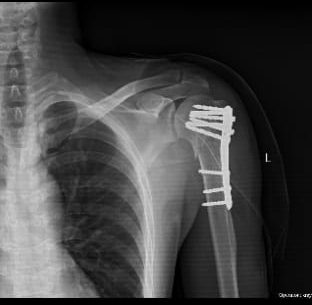
Approximately 80% of these fractures are minimally displaced and can heal without surgery. However, in 2-part, 3-part, or 4-part displaced configurations, the powerful pull of the rotator cuff muscles tugs the tuberosity fragments apart, causing joint incongruity and loss of active arm elevation.
Arm Sling vs. Surgery: How the Treatment Decision Is Made
Determining whether a broken shoulder requires an operation depends on fragment displacement, angulation, and patient functional demands.
When Conservative Arm Sling Care Works:
- Minimally Displaced Fractures: Fragments are angulated less than 45 degrees or shifted less than 1 centimeter with intact cortical contact.
- Medically Frail Elderly Patients: Low-demand lifestyle where the risks of anesthesia outweigh the benefits of anatomical reconstruction.
When Surgical Fixation (Locking Plate ORIF) Is Mandatory:
- Displaced Multi-Part Fractures: Greater or lesser tuberosity fragments separated by more than 5 to 10 millimeters, blocking smooth rotator cuff mechanics.
- Humeral Head Angulation (> 45°): Severe tilt of the ball that compromises the subacromial space and blocks overhead arm lifting.
- Head-Splitting or Fracture-Dislocations: High-energy impacts where the shoulder joint dislocates entirely while the humeral head splits open.
Surgical Techniques: Anatomical Locking Compression Plates (ORIF)
Modern surgical reconstruction of the shoulder utilizes Open Reduction and Internal Fixation (ORIF) via a deltoid-splitting or deltopectoral approach:
| Surgical Step | How It Is Performed | Biomechanical Advantage |
|---|---|---|
| 1. Fragment Reduction | Gentle manipulation under C-Arm X-ray guidance to restore the normal 130-to-140-degree neck-shaft angle of the humeral head. | Prevents varus collapse and restores normal shoulder biomechanics. |
| 2. Tuberosity Suture Fixation | High-strength non-absorbable sutures are passed through the rotator cuff tendon insertions and locked through eyelets in the plate. | Re-anchors the greater and lesser tuberosities securely, restoring internal and external rotation strength. |
| 3. Anatomical Locking Plating | A precontoured low-profile titanium locking plate is secured along the lateral humerus shaft. | Multiple fixed-angle locking screws form a rigid "fixed-angle scaffold" inside soft osteoporotic bone, preventing screw pullout. |
Risks of Neglected Fractures, Malunion & Avascular Necrosis
Failing to stabilize a displaced multi-part shoulder fracture or relying on prolonged rigid immobilization can result in permanent complications:
- Varus Malunion (Collapsed Humeral Head): If the humeral head heals tilted downward into a varus position, the greater tuberosity jams against the acromion bone during arm lifting, causing permanent impingement syndrome and chronic weakness.
- Avascular Necrosis (AVN): In severe 4-part fractures or fracture-dislocations where the blood vessels entering the humeral head are permanently torn, the bone of the ball can die and collapse over 12 to 24 months, eventually requiring shoulder replacement.
- Adhesive Capsulitis (Frozen Shoulder): Severe joint stiffness resulting from prolonged immobilization without early supervised pendulum exercises.
Time-Tested Imported Implants: Specialized Titanium Systems
The proximal humerus is subjected to complex rotational torques from the rotator cuff. Standard plates lack the multi-directional screw trajectories required to capture soft osteoporotic humeral heads.
Global Pioneer Systems Deployed at Our Center
We deploy certified, time-tested imported titanium proximal humerus locking plate systems engineered with suture eyelets and variable-angle locking holes:
These advanced implants allow secure screw subchondral support, preventing screw cutout and ensuring reliable fixation in elderly patients with weak bone density.
Operating Room Sterility: Protecting Shoulder Joint Integrity
Shoulder surgery requires meticulous aseptic technique to prevent deep infection that could destroy the joint capsule or compromise hardware stability.
Multi-Layered Trauma Infection Control Protocols
- Laminar Airflow Operating Theatres: Ultra-clean positive-pressure HEPA air circulation continuously sweeping airborne microbes away from the surgical field.
- CSSD Monitored Autoclave Sterilization: Audited sterilization cycles for all precision shoulder retractors, power drills, and depth gauges.
- Deltoid-Preserving Dissection: Anatomical surgical approaches protecting the axillary nerve and circumflex vessels, ensuring clean wound healing and rapid muscle rehabilitation.
Phased Recovery Timeline: From Sling to Overhead Mobility
Anatomical plate fixation provides stable internal alignment on Day 1, permitting early protected shoulder rehabilitation:
| Timeframe | Bone Healing & Soft-Tissue Status | Permitted Shoulder Function | Physiotherapy & Rehabilitation Focus |
|---|---|---|---|
| Week 1 to 3 | Incision heals; locking plate secures humeral head; initial soft-tissue repair consolidation. | Arm resting in a comfortable sling; pendulum swings (Codman exercises); active elbow, wrist, and hand movement. | Passive forward elevation and gentle external rotation up to safe surgical limits. |
| Weeks 4 to 6 | Early biological bone callus bridging across fracture fragments. | Discontinuing arm sling for daily indoor activities; light writing and computer work. | Active-assisted range of motion exercises; pulley-assisted overhead stretching. |
| Weeks 6 to 12 | Solid radiographic bone union visible on follow-up digital X-rays. | Carrying light objects (up to 2–3 kg); routine household chores; driving short distances. | Rotator cuff strengthening with light resistance bands; scapular stabilization drills. |
| Months 3 to 6 | Complete cortical remodeling and restoration of shoulder girdle strength. | Unrestricted overhead reach, swimming, gym workouts, and normal vocational duties. | Advanced proprioception, endurance conditioning, and full functional recovery. |
Surgery Costs & Cashless Mediclaim in Jamshedpur
Shoulder fracture surgery packages depend on the fracture complexity (2-part vs. multi-part displaced breaks), the selection of imported titanium locking plates, and the hospital room category selected.
Emergency Cashless Insurance & TPA Support
We cover almost all major private health insurance policies, corporate TPAs, and recognized health panels.
Because acute accidental shoulder fractures are treated as medical emergencies, most health policies cover hospitalization without standard waiting periods. Families should share the patient's insurance card and accident details directly on our clinic WhatsApp at +91 7739798850 for immediate pre-authorization desk assistance.
Confirm on whatsappOur administrative desk ensures transparent, upfront billing covering imported titanium plate costs, OT consumables, anesthesia fees, and follow-up care with zero hidden surprises.
Frequently Asked Questions by Patients & Families
How long does a broken shoulder (proximal humerus) take to heal?
Bone union typically occurs within 8 to 12 weeks. However, recovering full overhead shoulder elevation, rotational mobility, and strength takes 3 to 6 months of dedicated pendulum and progressive physiotherapy exercises.
Can a proximal humerus fracture be treated without an operation?
Yes. If the fracture fragments are undisplaced or minimally displaced and remain locked in stable alignment, conservative treatment with an arm sling and early pendulum exercises is highly successful. Surgery is required when fragments are displaced, rotated, or split into multiple parts.
What happens if a displaced multi-part shoulder fracture is not operated on?
Leaving a displaced multi-part fracture without fixation can lead to malunion in varus collapse, where the humeral head tilts downward, severely restricting overhead reach and causing chronic impingement and shoulder arthritis.
Will I get a frozen shoulder after shoulder fracture treatment?
Joint stiffness (adhesive capsulitis or frozen shoulder) is a common risk due to necessary immobilization. To prevent this, structured early pendulum exercises and passive range-of-motion drills are initiated as soon as stable fixation or initial pain control allows.
Is shoulder fracture surgery covered under cashless health insurance in Jamshedpur?
Yes. Acute traumatic shoulder fractures resulting from falls or road accidents are treated as emergency surgical admissions covered under private health insurance policies and corporate TPAs without waiting periods.
Clinical References & Scientific Evidence
1. Neer CS 2nd. "Displaced proximal humeral fractures. I. Classification and evaluation. II. Treatment of three-part and four-part displacement." The Journal of Bone & Joint Surgery (Am). 1970;52(6):1077-1089.
2. Rüedi TP, Buckley RE, Moran CG. "AO Principles of Fracture Management." AO Foundation / Thieme. 2007.
3. Handoll HH, Ollivere BJ. "Interventions for treating proximal humeral fractures in adults." Cochrane Database of Systematic Reviews. 2010;(12):CD000434.