Understanding Rotator Cuff Tears: Why Early Repair Protects the Joint
The rotator cuff is a coordinated dynamic sleeve of four tendons (Supraspinatus, Infraspinatus, Teres Minor, and Subscapularis) that converge to securely center the head of the arm bone (humeral head) inside the shallow glenoid socket of the shoulder blade.
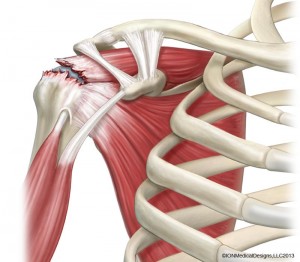
Tears most frequently involve the supraspinatus tendon. In our clinical practice in Jamshedpur, we see tears arising from two primary sources: acute trauma (falls on an outstretched hand, heavy weightlifting injuries) or chronic degenerative impingement (bone spurs rubbing the tendon in manual workers, engineers, and individuals over age 45).
Hallmark Symptoms That Indicate a Cuff Tear:
- Severe Night Pain: Inability to sleep on the affected shoulder; dull, unrelenting ache waking you from deep sleep.
- The Painful Arc & Weakness: Sharp catch when lifting the arm between 60° and 120°, accompanied by weakness when pouring a cup of tea or reaching for a car seatbelt.
- Loss of Active Overhead Elevation: The arm can be moved passively by another person, but the patient cannot actively hold or lift it up against gravity (Drop Arm Sign).
- Crepitus & Shoulder Catching: Noticeable popping or grating sensation beneath the acromion bone when rotating the arm.
All-Inside Keyhole Arthroscopy: Sparing the Deltoid Muscle
Traditional open shoulder surgery required detaching the powerful deltoid muscle from the clavicle and acromion, causing extensive postoperative pain and prolonged muscle healing. Today, we perform rotator cuff repair 100% arthroscopically through three or four puncture-sized 5 mm portals.
Footprint Preparation & Micro-Fracturing: Using high-definition 4K optical arthroscopes and motorized diamond burrs, the bony footprint on the greater tuberosity is gently decorticated. This opens subchondral vascular channels, allowing fresh bone marrow stem cells to seep into the repair site to accelerate true biological tendon-to-bone healing.
Double-Row Transosseous-Equivalent (TOE) SpeedBridge: Rather than using a weak single line of stitches, we compress the torn tendon across its entire anatomical footprint using an interconnected criss-cross matrix of ultra-high-strength suture tape. This delivers pressurized footprint contact, superior load distribution, and eliminates suture strangulation of the tendon's blood supply.
Time-Tested Imported Implants: Why We Never Compromise
In rotator cuff surgery, the repair relies entirely on the pullout strength of suture anchors buried into the humeral bone until the tendon biologically re-attaches over 8 to 12 weeks. Inferior or untested anchors can pull out under tension, leading to silent repair failure.
We exclusively deploy time-tested, FDA/CE-cleared imported sports medicine systems from world-renowned leaders, strictly rejecting non-standard copies:
Global Pioneer Systems We Routinely Deploy
These advanced systems feature decades of peer-reviewed biomechanical testing and exceptional clinical pullout strength:
| Device Category | Imported Gold-Standard Systems | Clinical Advantages & Ingrowth Biology |
|---|---|---|
| Knotless Biocomposite Anchors | Arthrex SwiveLock® C / PEEK Smith & Nephew HEALICOIL™ REGENESORB™ |
Open-architecture biocomposite anchors (PLDLA + β-TCP). Promotes native bone marrow growth directly into the anchor threads while eliminating bulky suture knots that cause subacromial friction. |
| Broad-Band Suture Tapes | Arthrex FiberTape® Smith & Nephew ULTRABRAID™ |
Flat, wide-profile collagen-friendly tapes that disperse compressive loads evenly across the tendon footprint, preventing "cheese-wiring" cuts through fragile degenerate tendon tissue. |
| Subscapularis & Medial Anchors | Arthrex Corkscrew® FT Smith & Nephew TWINFIX™ Ultra |
Full-threaded titanium or PEEK anchors offering maximum cortical purchase in softer, osteopenic bone common in elderly patients. |
Comprehensive Joint Clearance: Acromioplasty & Biceps Management
A rotator cuff tear rarely occurs in total isolation. During keyhole arthroscopy, we thoroughly inspect and address associated pain generators within the shoulder:
- Subacromial Decompression & Acromioplasty: The hooked bone spur (Bigliani Type II/III acromion) rubbing against the tendon is precisely smoothed with a burr, creating ample clearance space to prevent re-impingement.
- Biceps Tenodesis / Tenotomy: The long head of the biceps tendon often shows fraying, subluxation, or chronic tendonitis inside the bicipital groove. Re-anchoring it outside the joint (tenodesis) or releasing it (tenotomy) permanently relieves anterior shoulder pain without sacrificing arm strength.
- Subacromial Bursectomy: Complete excision of the chronically inflamed, thickened subacromial bursa that causes sharp nighttime throbbing.
Operating Room Sterility: Protecting Your Reattached Tendon
In shoulder arthroscopy, pressurized saline fluid continuously distends the subacromial space. Maintaining unyielding sterility of the arthroscopic fluid circuit, camera portals, and bone-anchoring systems is critical to prevent deep joint sepsis or implant extrusion.
We perform all shoulder surgeries exclusively in accredited hospital operating theatres meeting rigorous infection-control benchmarks:
Multi-Layered Surgical Infection Safeguards
- Laminar Airflow Operating Theatres: Continuous positive-pressure HEPA filtration sweeping airborne particulates away from the sterile drape boundaries.
- Central Sterile Services (CSSD): Monitored autoclave and plasma sterilization cycles for all precision fiberoptic cables, radiofrequency wands, and cannulas.
- Dedicated Arthroscopy Scrub Teams: Operation theatre nurses and technicians specifically trained in sterile fluid pump management and implant delivery.
- Impermeable Drapes with Fluid Pouches: Advanced barrier drapes with integrated drainage collection to keep surgical margins strictly dry and sterile.
Maintaining advanced HEPA laminar air systems and deploying time-tested imported implants contributes to the overall surgical package cost. However, this investment safeguards your tendon repair against catastrophic deep infection, ensuring predictable healing and long-term joint function.
Phased Shoulder Rehabilitation: Respecting Tendon Biology
Tendon-to-bone healing follows a strict biological calendar. Because muscles cannot contract strongly until the tendon fuses to bone, rehabilitation proceeds through disciplined, guided phases:
| Rehab Phase | Clinical Focus & Protection | Permitted Activities |
|---|---|---|
| Phase 1 (Weeks 0–4) | Strict sling immobilization; passive pendulum motions; grip and elbow flexion drills. | Passive forward flexion to 90°; gentle pendulum swings; no active lifting or driving. |
| Phase 2 (Weeks 5–8) | Weaning from abduction sling; active-assisted range of motion (AAROM). | Pulley exercises, wand exercises, supine elevation; resuming light desk work. |
| Phase 3 (Weeks 9–14) | Restoring full active range of motion (AROM); scapular stabilizer strengthening. | Light resistance therabands, internal/external rotation drills, driving automatic cars. |
| Phase 4 (Months 4–6+) | Progressive deltoid & rotator cuff strengthening; functional overhead capacity. | Return to swimming, badminton, gym fitness training, and unrestricted occupational duty. |
Surgery Costs & Cashless Insurance in Jamshedpur
The overall package cost of arthroscopic rotator cuff repair depends on tear size (single anchor vs. massive tear requiring 3 to 4 double-row anchors), associated biceps tenodesis requirements, and selected hospital room categories.
Comprehensive Cashless Insurance Support
We cover almost all major private health insurance policies, corporate TPAs, and recognized health panels.
Because coverage, room-rent limits, copay terms, and waiting periods vary widely between individual insurance policies and corporate networks, please share your policy card directly via WhatsApp prior to admission to check your eligibility and ensure smooth cashless pre-authorization.
Confirm Insurance on WhatsAppOur clinical team provides transparent pre-operative financial counseling covering imported suture anchors, radiofrequency ablation probes, shaver blades, abduction braces, and post-discharge physical therapy pathways.
Frequently Asked Questions About Rotator Cuff Tears
What happens if I choose not to operate on a full-thickness tear?
Small, symptomatic tears tend to enlarge over time under constant muscular pull. If left unrepaired for years, the tendon retracts into the chest wall and the muscle undergoes irreversible fatty degeneration, eventually leading to cuff tear arthropathy where only a reverse shoulder replacement can help.
How long do I have to wear the shoulder abduction sling?
Patients wear an abduction sling for approximately 4 to 5 weeks. This keeps the arm in slight outward abduction, taking direct mechanical tension off the suture anchor repair while initial biological healing forms.
How painful is keyhole shoulder surgery?
During surgery and the first 24 to 36 hours, severe pain is prevented using an ultrasound-guided Interscalene Brachial Plexus Block performed by our specialist anaesthetist. Combined with modern multimodal oral analgesics, post-op discomfort is smoothly controlled.
When can I return to driving and office work?
Sedentary desk work and computer typing can often resume within 10 to 14 days using your hand while resting in the sling. Driving is safely permitted once the sling is removed and emergency evasive steering control is restored (typically around 6 to 8 weeks).
Clinical References & Literature
1. Hein J, et al. "Retear Rates After Arthroscopic Rotator Cuff Repair: A Meta-analysis With Best-Case and Worst-Case Analysis." The American Journal of Sports Medicine. 2015;43(10):2562-2570.
2. Frank RM, et al. "Double-row versus single-row arthroscopic rotator cuff repair: a systematic review and meta-analysis of prospective randomized controlled trials." Journal of Shoulder and Elbow Surgery. 2014;23(8):1136-1146.
3. Barber FA, et al. "Cyclic loading and ultimate pullout strength of knotless suture anchors in human cadaveric bone." Arthroscopy. 2013;29(8):1378-1385.