Comprehensive Shoulder Girdle Anatomy & Injury Patterns
The shoulder is a complex mechanical complex comprising two main skeletal structures prone to traumatic injury: the clavicle (collarbone) acting as the upper torso strut, and the proximal humerus forming the ball-and-socket joint of the shoulder itself. Injuries to either component—whether from a two-wheeler skid on Marine Drive, a sports tackle, or a fall on an outstretched hand—compromise upper limb mobility and overhead reach.

Depending on whether the break occurs along the collarbone or the upper arm head, surgical treatment ranges from precontoured locking plates and elastic intramedullary nails to anatomical humeral head locking plates.
Clavicle (Collarbone) Fracture: Plating vs. Intramedullary Nailing
Approximately 80% of collarbone breaks occur in the middle third. Because powerful neck and chest muscles pull the fragments out of alignment, displaced midshaft fractures require surgical stabilization to prevent permanent shortening or non-union.
Clavicle Treatment Options:
- Precontoured Locking Plating (ORIF): A 6–9 cm horizontal incision accommodating absolute rigidity for comminuted, shattered, or displaced breaks.
- Elastic Intramedullary Nailing (TEN Rod): A keyhole technique using tiny 1-cm incisions to slide a flexible titanium rod inside the marrow cavity, ideal for clean midshaft breaks with smaller scars and faster soft-tissue recovery.
Proximal Humerus (Shoulder Head) Fracture: Sling vs. Locking Plate ORIF
Proximal humerus fractures involve the spherical ball of the shoulder and the greater/lesser tuberosities where rotator cuff tendons attach. While undisplaced fractures heal in an arm sling with early pendulum exercises, displaced multi-part fractures require surgical intervention.
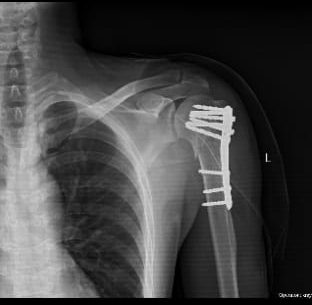
Humeral Plating (ORIF): Performed via a deltoid-splitting or deltopectoral approach, utilizing multi-directional fixed-angle locking screws to reconstruct shattered humeral heads and re-anchor torn rotator cuff insertions securely.
Shoulder & Collarbone Surgical Fixation Methods
Matching the correct surgical technique to the exact shoulder injury ensures optimal restoration of form and function:
| Injury Type | Primary Surgical Technique | Implant / Hardware Used | Functional Goal |
|---|---|---|---|
| Clavicle Midshaft Break | Open Reduction & Internal Fixation (ORIF) | Precontoured Superior Titanium Locking Plate | Restores clavicular length and eliminates shoulder girdle drooping. |
| Simple Clavicle Break | Closed Reduction & Intramedullary Nailing | Titanium Elastic Nail (TEN Rod) | Keyhole stabilization with minimal scarring and preserved biological hematoma. |
| Proximal Humerus Break | Anatomical Locking Plate ORIF | Proximal Humerus Locking Compression Plate (PHILOS/Provital) | Reconstructs humeral head angle and re-anchors rotator cuff tendons. |
Risks of Neglected Fractures, Malunion & AVN
Allowing displaced shoulder girdle fractures to heal without proper anatomical alignment leads to long-term disability:
- Clavicular Shortening & Scapular Dyskinesis: Collarbone shortening over 2 cm rotates the shoulder girdle inward, causing chronic upper back fatigue and burning pain.
- Varus Malunion of Humeral Head: Humeral head healing in a collapsed downward tilt causes chronic subacromial impingement and severe restriction of overhead reach.
- Avascular Necrosis (AVN) & Frozen Shoulder: Severe 4-part proximal humerus fractures can cut off blood supply to the ball, while joint stiffness sets in if early pendulum exercises are omitted.
Time-Tested Imported Implants: Advanced Titanium Systems
Shoulder bones require low-profile implants that conform smoothly to natural curves without causing skin irritation or screw pullout in osteoporotic bone.
Global Pioneer Systems Deployed at Our Center
We deploy certified, time-tested imported titanium clavicle plates, TEN rods, and proximal humerus locking systems:
These systems feature tapered designs and multi-directional screw locking that provide secure subchondral support under active rotational loads.
Operating Room Sterility & Neurovascular Protection
Shoulder and collarbone surgery involve close proximity to major vascular structures (subclavian vessels) and nerve plexuses (brachial plexus and axillary nerve). Absolute precision and sterility are mandatory.
Multi-Layered Trauma Infection Control & Safety Protocols
- Laminar Airflow Clean Theatres: Continuous positive-pressure, HEPA-filtered operating suites shielding implants from airborne contamination.
- Nerve-Preserving Dissection: Careful identification and mobilization of supraclavicular and axillary nerve branches to prevent postoperative numbness or weakness.
- Subcuticular Aesthetic Closure: Tension-free layered closure using fine absorbable sutures for clean, fading scar lines.
Phased Recovery Timeline: From Surgery to Full Overhead Reach
Stable surgical fixation allows early guided mobilization while biological bone union solidifies across the shoulder girdle:
| Timeframe | Bone & Soft-Tissue Status | Permitted Shoulder Function | Physiotherapy & Rehabilitation Focus |
|---|---|---|---|
| Week 1 to 3 | Incision heals cleanly; internal plates or nails stabilize bone fragments; pain subsides. | Gentle pendulum swings (Codman exercises); free elbow, wrist, and hand movement. | Arm sling worn for outdoor comfort; passive forward elevation up to safe surgical limits. |
| Weeks 4 to 6 | Soft callus bridging across fracture gaps; early biological revascularization. | Discontinuing arm sling for indoor activities; light typing, dressing independently. | Active-assisted range of motion exercises; pulley-assisted overhead stretching. |
| Weeks 6 to 12 | Solid radiographic bone union visible on follow-up digital X-rays. | Carrying light objects (up to 3–5 kg); routine household tasks; driving short distances. | Progressive rotator cuff strengthening, resistance band pulls, active stretching. |
| Months 3 to 6 | Complete cortical remodeling along dynamic lines of chest and arm stress. | Full sports return, gym workouts, heavy manual labor, and normal vocational duties. | Push-ups, swimming, heavy lifting, and advanced conditioning. |
Surgery Costs & Cashless Mediclaim in Jamshedpur
Shoulder and collarbone fracture surgery package expenses vary based on injury complexity (clavicle midshaft vs. multi-part proximal humerus), the choice of imported titanium plates or nails, and hospital room category.
Emergency Cashless Insurance & TPA Support
We cover almost all major private health insurance policies, corporate TPAs, and recognized health panels.
Because acute accidental shoulder and collarbone fractures are treated as medical emergencies, most health policies cover hospitalization without standard waiting periods. Families should share the patient's insurance card and accident details directly on our clinic WhatsApp at +91 7739798850 for immediate pre-authorization desk assistance.
Confirm on whatsappOur administrative desk ensures transparent, upfront billing covering imported titanium plate/nail costs, OT consumables, anesthesia fees, and follow-up care with zero hidden surprises.
Frequently Asked Questions by Patients & Families
What are the common types of shoulder fractures treated?
Shoulder girdle fractures primarily involve the clavicle (collarbone strut) and the proximal humerus (the ball-and-socket joint of the shoulder). Both typically result from falls onto an outstretched hand or direct lateral impact during road accidents or sports.
What is the difference between plating and nailing for a collarbone (clavicle) fracture?
Plating uses a precontoured titanium locking plate screwed along the top or front of the bone for absolute rigidity in complex breaks. Nailing (TEN rod) is a keyhole technique inserting a flexible titanium rod inside the marrow cavity, ideal for simple midshaft breaks with smaller scars.
How is a proximal humerus shoulder fracture treated?
Minimally displaced fractures heal successfully in an arm sling with early pendulum exercises. Displaced multi-part fractures and severe angulation require Open Reduction and Internal Fixation (ORIF) using specialized anatomical locking compression plates.
How long does a shoulder fracture take to heal?
Most shoulder girdle fractures achieve radiographic and clinical bone union in 8 to 12 weeks. Restoring full overhead elevation, rotational mobility, and strength typically requires 3 to 4 months of structured rehabilitation.
Is shoulder fracture surgery covered under cashless health insurance in Jamshedpur?
Yes. Acute traumatic shoulder and collarbone fractures resulting from accidents or falls qualify as emergency surgical admissions covered under private health insurance policies and corporate TPAs without waiting periods.
Clinical References & Scientific Evidence
1. Canadian Orthopaedic Trauma Society. "Nonoperative treatment compared with plate fixation of displaced midshaft clavicular fractures." The Journal of Bone & Joint Surgery (Am). 2007;89(1):1-10.
2. Neer CS 2nd. "Displaced proximal humeral fractures. I. Classification and evaluation." The Journal of Bone & Joint Surgery (Am). 1970;52(6):1077-1089.
3. Rüedi TP, Buckley RE, Moran CG. "AO Principles of Fracture Management." AO Foundation / Thieme. 2007.