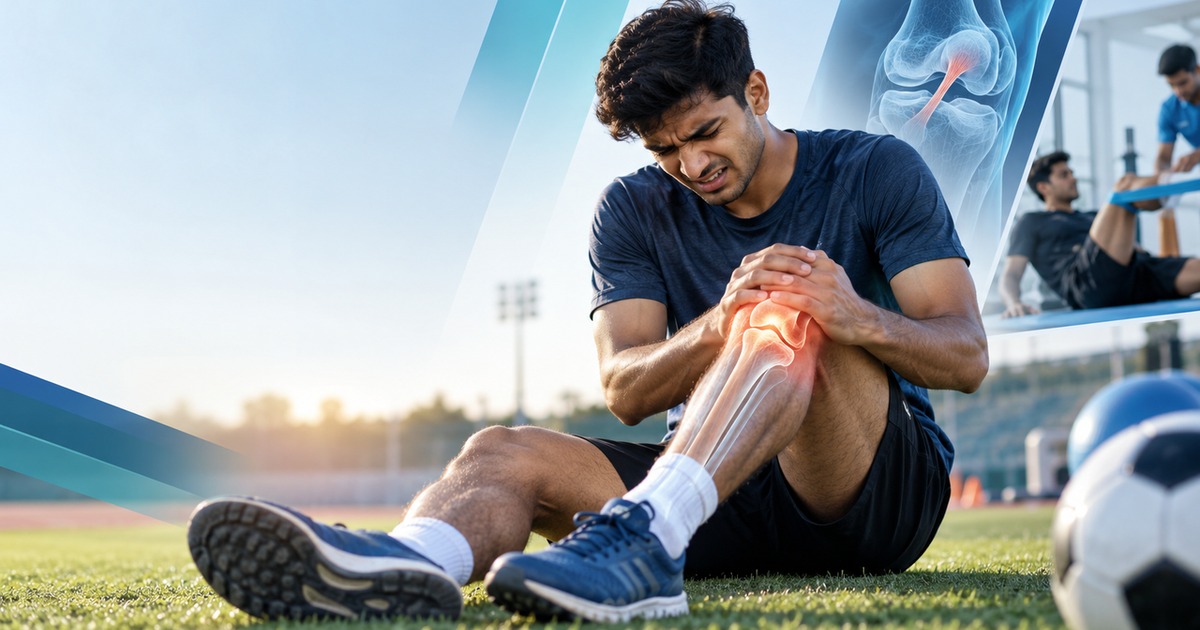
What Is a Sports Injury?
A sports injury is an injury to a bone, joint, ligament, tendon, muscle or cartilage that occurs during sport, exercise, training or another physically demanding activity. It can happen after a single event—such as a twisting injury, fall, collision or awkward landing—or develop gradually because the body is repeatedly exposed to more load than it can currently tolerate.
Good treatment is not simply about reducing pain. The aim is to identify the injured structure, restore movement and strength, rebuild sport-specific capacity, and reduce the risk of persistent symptoms or re-injury. Current sports-medicine consensus views return to sport as a progressive process rather than a single clearance decision at the end of rehabilitation. Bern Return-to-Sport Consensus.
The treatment plan should be individualised
The same diagnosis can require different treatment in a school athlete, recreational runner, cricket player, footballer, gym athlete or professional competitor. Age, sport, level of participation, injury severity, associated injuries, previous injuries, work or study demands and the athlete's goals all influence the treatment pathway.
Common Sports Injuries Treated
Sports injuries can affect almost any part of the musculoskeletal system. Common problems seen in orthopaedic sports practice include:
Knee Injuries
- ACL, PCL and collateral ligament injuries
- Meniscus tears and ramp/root injuries
- Patellar instability and dislocation
- Patellar tendinopathy and anterior knee pain
- Cartilage and osteochondral injuries
- Multi-ligament knee injuries
Shoulder Injuries
- Shoulder dislocation and recurrent instability
- Labral injuries including Bankart lesions
- Rotator cuff tears and tendinopathy
- AC joint injuries
- Throwing-related shoulder pain
- Biceps and SLAP-region pathology
Ankle & Foot
- Lateral ankle ligament sprains
- Chronic ankle instability
- Achilles and other tendon injuries
- Stress injuries and selected fractures
- Cartilage/osteochondral lesions
- Sports-related forefoot and midfoot problems
Muscle & Tendon Injuries
- Hamstring strains and tears
- Quadriceps and calf injuries
- Adductor/groin injuries
- Tendon overload and tendinopathy
- Muscle contusions
- Recurrent muscle injuries
Important: pain after exercise is not automatically a serious injury, but recurrent pain, swelling, instability, locking, loss of strength or inability to perform normal sport-specific movements deserves assessment.
How a Sports Injury Is Diagnosed
A diagnosis begins with a detailed history and physical examination. Imaging is used when it is likely to answer a clinical question—not simply because an athlete has pain.
- Understand the mechanism: twisting, landing, sprinting, collision, fall, direct blow, repetitive overhead activity or gradual overload.
- Map the symptoms: pain location, swelling, clicking, locking, giving-way, weakness, stiffness and loss of performance.
- Examine the injured region: range of motion, tenderness, stability, strength, neurovascular status and sport-specific functional limitations.
- Screen for associated injury: for example, an ACL injury may coexist with meniscal or cartilage damage; shoulder instability may involve labral injury.
- Use imaging selectively: X-ray is important for suspected fracture or bony injury; ultrasound can be useful for selected superficial tendon and muscle problems; MRI is particularly useful for many internal joint, ligament, meniscal, cartilage and muscle injuries.
- Build a treatment pathway: observation/rehabilitation, protected loading, medication when appropriate, injection in selected conditions, or surgery when the expected benefit outweighs non-operative care.
MRI is a tool—not the diagnosis
MRI findings must be interpreted together with the history and examination. Some abnormalities can be present without being the cause of symptoms. Conversely, an important injury can occasionally be missed if the clinical examination and imaging are not considered together.
What to Do Immediately After a Sports Injury
For an acute injury, the priority is to protect the injured area while arranging appropriate assessment. Do not force an athlete to continue playing through a suspected significant injury.
Protect & Modify Activity
Stop the movement that caused the pain. Use a brace, taping, crutches or other support when indicated by the injury severity.
Control Symptoms
Relative rest, elevation, compression and intermittent cooling may help symptoms in appropriate acute injuries. Avoid aggressive massage or stretching immediately after a suspected muscle or ligament tear.
Progressive Loading
Complete immobilisation is not required for every injury. Where safe, loading should be gradually restored according to symptoms, tissue healing and functional capacity.
Get Assessed When Needed
Marked swelling, inability to bear weight, deformity, locking, recurrent instability, significant weakness or suspected fracture warrants medical assessment.
For lateral ankle sprains, evidence-based guidelines support external support and progressive weight bearing according to severity, together with structured therapeutic exercise; more severe injuries may require a short period of immobilisation.
Non-Surgical Sports Injury Treatment
Many sports injuries improve without an operation. Non-surgical care is often the first-line approach for appropriate injuries and may also be used before surgery to restore movement and strength.
Activity Modification
Temporarily reduce the specific movement that provokes symptoms while maintaining safe fitness activities whenever possible.
Physiotherapy & Exercise
Progressive strength, mobility, neuromuscular control, balance, endurance and sport-specific conditioning form the foundation of rehabilitation for many injuries.
Bracing / Taping
Used selectively for instability, ankle sprains, patellar instability and other conditions when external support can improve protection or function.
Medication
Pain-relieving medicines may be considered after reviewing age, medical history, other medicines, allergies and contraindications. Do not self-prescribe prolonged anti-inflammatory treatment.
For acute isolated meniscal tears, the 2024 AAOS guideline supports clinical examination and MRI when appropriate, and emphasises preserving functional meniscal tissue when surgery is indicated. It also recognises a role for physical therapy/rehabilitation in selected non-displaced tears and during recovery.
Knee Sports Injuries: ACL, Meniscus, PCL & More
The knee is especially vulnerable to twisting, pivoting, landing and contact injuries. A detailed assessment is important because several structures can be injured at the same time.
| Injury | Typical symptoms | Possible treatment pathway |
|---|---|---|
| ACL tear | Pop, rapid swelling, instability, difficulty pivoting | Rehabilitation for selected patients; reconstruction may be considered for persistent instability or patients whose sport/demands favour surgical stabilisation. |
| Meniscus tear | Joint-line pain, catching, clicking, swelling, locking in some tears | Activity modification and rehabilitation for selected tears; repair is considered when the tear has healing potential and symptoms/instability warrant surgery. |
| MCL / collateral ligament | Pain and tenderness along the ligament, instability in more severe injuries | Often non-operative with protection and progressive rehabilitation; complex or combined injuries need specialist assessment. |
| PCL injury | Deep knee pain, swelling, instability, difficulty with stairs or deceleration | Severity and associated injuries determine non-operative versus reconstructive management. |
| Patellar instability | Kneecap slipping, apprehension, swelling after dislocation | Rehabilitation for selected first episodes; recurrent instability or significant structural injury may require stabilisation. |
The AAOS 2022 ACL guideline notes that both operative and non-operative approaches can be appropriate depending on the individual, and that activity level, skeletal maturity and functional goals matter.
Shoulder Sports Injuries
Overhead athletes, swimmers, throwers, gym athletes and contact-sport players may develop instability, labral injuries, rotator cuff problems or AC-joint injuries.
- Shoulder dislocation/instability: assessment looks for instability, bone loss, labral injury and the athlete's age and sport.
- Rotator cuff injury: treatment may include activity modification, progressive strengthening and selected surgical repair when clinically appropriate.
- Throwing-related pain: rehabilitation should address the shoulder as part of the kinetic chain, including scapular control, trunk and lower-limb contribution and progressive throwing load.
- AC joint injury: severity, displacement and sport requirements influence treatment.
The 2025 AAOS Clinical Practice Guideline on rotator cuff injuries provides current evidence-based recommendations for adult rotator cuff injuries and highlights that treatment decisions should be based on the individual clinical situation rather than imaging alone.
Ankle Sprains & Chronic Ankle Instability
A simple ankle sprain can become a recurrent problem if pain improves before balance, strength and movement control are restored. Examination should include swelling, range of motion, ligament stability, balance and functional performance.
Evidence-based ankle guidelines recommend external support and progressive weight bearing according to severity, plus structured exercise including range of motion, neuromuscular training and balance work. For recurrent instability, proprioceptive and neuromuscular exercise is an important component of rehabilitation.
When an ankle sprain needs closer assessment
Consider assessment when there is inability to bear weight, marked swelling, bony tenderness, recurrent giving-way, persistent pain, suspected syndesmotic injury, or symptoms that do not follow the expected recovery pattern.
Hamstring, Calf, Quadriceps & Groin Injuries
Muscle injuries require more than simply waiting for pain to disappear. Rehabilitation should restore the capacity required for sprinting, acceleration, deceleration, jumping and sport-specific movements.
International hamstring consensus recommends individualised rehabilitation based on the athlete, sport, injured tissue and severity. Progression should consider symptoms, strength, response to previous loading and the demands of running and sprinting; late rehabilitation should prepare the athlete for the actual demands of competition.
| Stage | Typical focus | Goal before progression |
|---|---|---|
| Early | Protect injured tissue, restore comfortable movement, low-load activation | Symptoms controlled and basic movement tolerated |
| Middle | Progressive strength, especially in positions relevant to sport | Increasing load tolerated without symptom flare |
| Running phase | Progressive running, acceleration and later sprint exposure | Sport-specific speed and loading tolerated |
| Return-to-sport | Change of direction, reactive drills, fatigue exposure and sport skills | Functional and psychological readiness for the actual sport |
When Is Arthroscopic Surgery Considered?
Arthroscopy is a minimally invasive technique in which a small camera and specialised instruments are introduced through small portals. It can be used for selected knee and shoulder injuries.
- ACL reconstruction: selected athletes and patients with symptomatic instability or high functional demands.
- Meniscus repair: selected repairable tears where preservation of functional meniscal tissue is desirable.
- Shoulder instability: selected recurrent instability and labral injuries.
- Rotator cuff repair: selected symptomatic tears when surgery is expected to provide meaningful benefit.
- Cartilage/osteochondral problems: selected cases after careful assessment.
Surgery is not automatically better than rehabilitation
The decision should consider the diagnosis, symptoms, instability, functional demands, age, associated injuries, previous treatment and evidence for benefit. A scan by itself is not an indication for surgery.
Rehabilitation: The Core of Sports Injury Recovery
Rehabilitation is a progressive training process designed to restore the capacities needed for daily life and sport. Depending on the injury, it can include mobility, strength, balance, coordination, aerobic fitness, running, jumping, landing, deceleration, change of direction and sport-specific skill work.
| Rehabilitation component | What it aims to restore |
|---|---|
| Mobility | Comfortable joint and soft-tissue movement |
| Strength | Muscle capacity and side-to-side symmetry where relevant |
| Neuromuscular control | Balance, coordination, landing and joint control |
| Energy-system fitness | Ability to tolerate the cardiovascular demands of the sport |
| Running & jumping | Gradual exposure to impact and elastic loading |
| Sport-specific work | Movement patterns and decisions required in the athlete's actual sport |
| Psychological readiness | Confidence, fear of re-injury and readiness to resume competition |
Return-to-sport consensus recommends a criterion-based and shared decision-making approach. The athlete may move through return to participation, return to sport and finally return to performance rather than being given a single yes/no clearance date.
Safe Return to Sport: What Does “Ready” Mean?
Being pain-free while walking is not enough for every sport. A footballer, cricketer, runner and swimmer have very different physical demands.
Symptoms
Minimal or no clinically significant pain, swelling or instability with required activities.
Movement
Appropriate range of motion and controlled sport-specific movement patterns.
Strength & Power
Strength and power sufficient for the sport, interpreted with appropriate side-to-side and individual benchmarks.
Functional Tests
Jumping, hopping, running, agility, deceleration or other tests relevant to the sport and injury.
Sport-Specific Load
Progressive exposure to the speed, volume, contact, cutting, throwing or endurance demands of competition.
Psychological Readiness
Confidence and appropriate risk awareness rather than pressure to return prematurely.
For ACL rehabilitation, AAOS states that functional evaluation such as hop testing may be considered as one factor in return-to-sport decisions.
Sports Injury Prevention
Injury prevention is not a guarantee that an athlete will never get injured. It is about reducing modifiable risk and improving the body's ability to tolerate sporting load.
- Warm up progressively before high-intensity activity.
- Maintain sport-specific strength and conditioning throughout the season.
- Train landing, deceleration and change-of-direction technique where relevant.
- Progress training volume and intensity rather than making sudden large increases.
- Use appropriate footwear and protective equipment.
- After an injury, complete rehabilitation rather than stopping when pain first disappears.
- For recurrent ankle sprains, bracing and balance/proprioceptive exercise can reduce recurrence risk.
- For ACL injury prevention, structured injury-prevention training programmes can reduce primary ACL injury risk in athletes participating in high-risk sports.
When a Sports Injury Needs Urgent Medical Assessment
Do not continue playing and seek urgent assessment if there is:
- Obvious deformity or suspected fracture/dislocation
- Loss of circulation, numbness or marked weakness
- Severe pain after a significant collision or fall
- Inability to bear weight after a major injury
- A knee or shoulder that is locked or cannot be moved normally
- Repeated joint giving-way after an acute injury
- Rapid large swelling after a twisting knee injury
- Head injury with concerning neurological symptoms, worsening headache, repeated vomiting, confusion, seizure or loss of consciousness
For suspected concussion, athletes should be removed from play and assessed appropriately rather than returning immediately. The 6th International Consensus on Concussion in Sport recommends a graduated return-to-sport strategy, with medical oversight for later stages involving risk of head impact.
Sports Injury Treatment in Jamshedpur
Dr. Pritpal Singh Saini provides orthopaedic consultation for sports injuries in Jamshedpur, with a focus on knee and shoulder sports injuries, arthroscopy, ligament injuries, meniscal problems, fracture care and rehabilitation planning.
Clinical Assessment
History, focused musculoskeletal examination and appropriate imaging recommendations.
Knee & Shoulder Arthroscopy
Evaluation and surgical management of selected ligament, meniscus, instability, cartilage and shoulder problems.
Rehabilitation Planning
Progressive rehabilitation and functional milestones tailored to the patient's injury and sport.
Return-to-Sport Guidance
Gradual progression toward running, agility, sport-specific drills and competition when clinically appropriate.
Practice locations: MedbeW Clinic, Golmuri; Gurunanak Hospital, Mango; Brahmanandam Hospital, Sonari; and Sadar Hospital, Khasmahal, Jamshedpur, according to the consultation schedule.
Frequently Asked Questions About Sports Injuries
Which sports injuries can you treat?
Common problems include ACL/PCL and collateral ligament injuries, meniscus tears, shoulder instability and labral injuries, rotator cuff problems, ankle sprains and instability, hamstring and muscle injuries, tendon disorders, cartilage injuries and sports-related fractures.
Do all sports injuries need an MRI?
No. Many injuries can be diagnosed clinically and treated without MRI. MRI is selected when the result is likely to change management or when internal structural injury needs clarification.
Does every ACL tear require surgery?
No. Both operative and non-operative treatment can be appropriate in selected patients. The decision depends on instability, activity level, sport, associated injuries, skeletal maturity, symptoms and rehabilitation response.
Can a meniscus tear heal without surgery?
Some tears can be managed with rehabilitation and activity modification, depending on tear pattern, symptoms and stability. Displaced tears that restrict movement or tears suitable for repair may require earlier surgical consideration.
How quickly can I return to sport?
There is no universal timetable. Return should be based on symptoms, healing, strength, functional performance, sport-specific capacity and psychological readiness—not simply the number of weeks since injury.
Can I exercise while recovering?
Often yes, but the exercise must be appropriate to the injury stage. The aim is usually to maintain safe fitness while progressively loading the injured structure according to symptoms and tissue healing.
When should I see an orthopaedic sports injury specialist?
Consider assessment for significant swelling, instability, locking, inability to bear weight, persistent pain, recurrent injury, loss of performance, suspected fracture/dislocation, or symptoms that are not improving as expected.
Authentic Clinical References
The following sources were selected from major professional organisations and peer-reviewed sports-medicine literature. They are intended as evidence sources for patient education; individual treatment should be based on clinical assessment.
- American Academy of Orthopaedic Surgeons (AAOS). Management of Anterior Cruciate Ligament Injuries. Clinical Practice Guideline, 2022. AAOS guideline.
- Ardern CL, et al. 2016 Consensus statement on return to sport from the First World Congress in Sports Physical Therapy, Bern. British Journal of Sports Medicine. 2016;50:853-864. DOI: 10.1136/bjsports-2016-096278. BJSM.
- American Academy of Orthopaedic Surgeons (AAOS). Clinical Practice Guideline for the Management of Acute Isolated Meniscal Pathology, 2024. AAOS guideline.
- American Academy of Orthopaedic Surgeons (AAOS). Management of Rotator Cuff Injuries Evidence-Based Clinical Practice Guideline, 2025. AAOS guideline.
- Martin RL, et al. Ankle Stability and Movement Coordination Impairments: Lateral Ankle Ligament Sprains Revision 2021. Journal of Orthopaedic & Sports Physical Therapy. 2021;51(4):CPG1-CPG80. DOI: 10.2519/JOSPT.2021.0302. JOSPT.
- Paton BM, et al. London International Consensus and Delphi study on hamstring injuries part 3: rehabilitation, running and return to sport. British Journal of Sports Medicine. 2023;57:278-288. DOI: 10.1136/bjsports-2021-105384. BJSM.
- Patricios JS, et al. Consensus statement on concussion in sport: the 6th International Conference on Concussion in Sport—Amsterdam, October 2022. British Journal of Sports Medicine. 2023;57:695-711. BJSM.
- Panther Symposium ACL Treatment Consensus Group. Treatment after ACL injury: Panther Symposium ACL Treatment Consensus Group. British Journal of Sports Medicine. 2021;55:14-22.